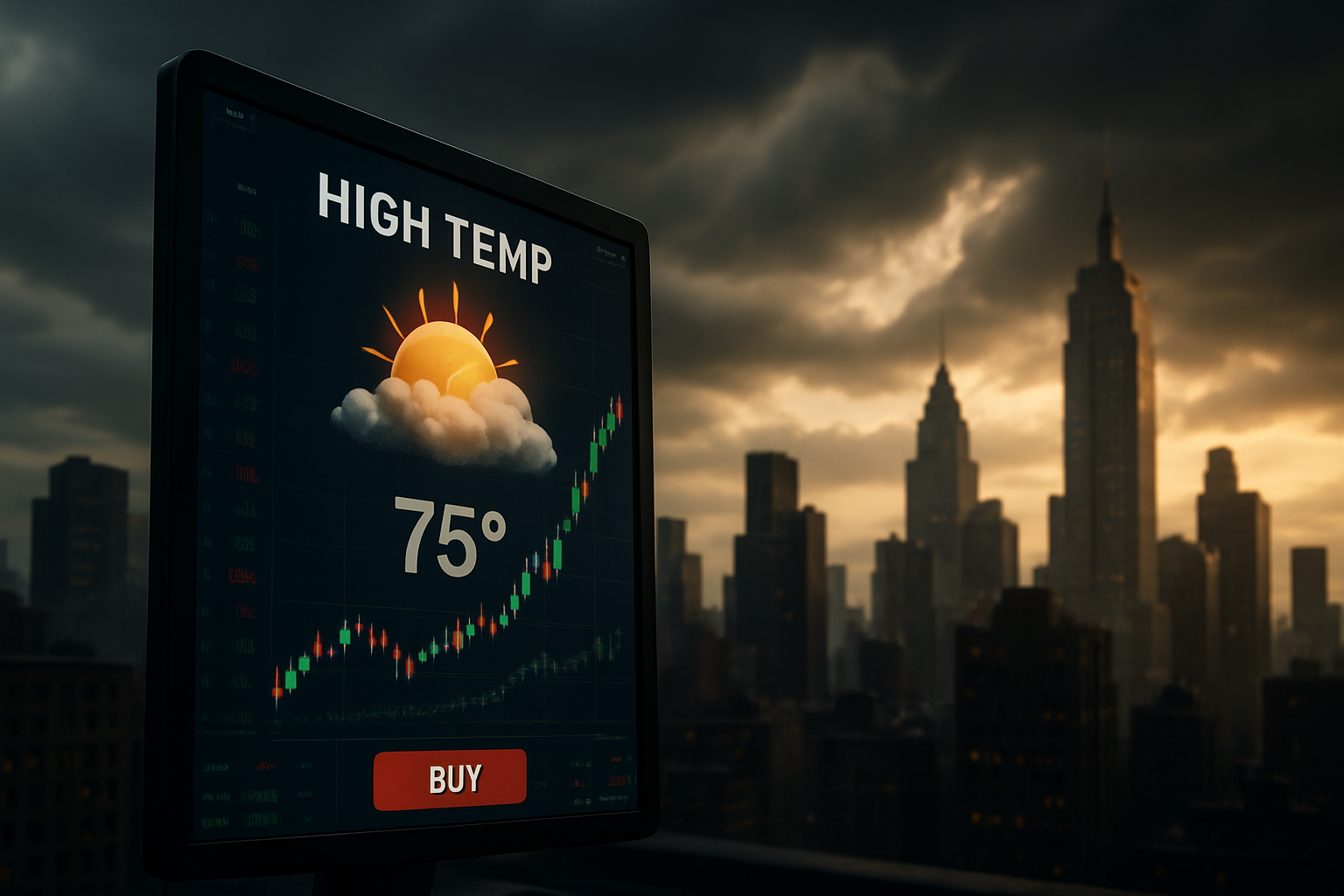
Kalshi lets you trade tomorrow's weather. Every day it lists markets on the highest temperature in several US cities, split into narrow ranges, and each range pays $1 if the official high lands in it. The contracts settle the next morning on the National Weather Service's Daily Climate Report — for New York City, the reading from Central Park — so the answer is a single published number that nobody can argue with.
Kalshi weather markets are some of the most distinctive contracts in the category. They are short, frequent, grounded in public data, and — unlike sports or elections — they reward the skill of reading forecasts rather than the skill of reading people. They also have quirks that catch out newcomers: which weather station counts, what "today" means to the Weather Service, and how quickly the price converges once the afternoon arrives.
This guide covers how the markets work, exactly how they settle, where traders find an edge, how prices move through the day, and how businesses can use them to hedge. Kalshi also lists monthly rain and other weather contracts, covered below.
| Market | Question it asks | Settles on | When it settles |
|---|---|---|---|
| Daily high temperature | What will today's highest temperature be at the named station? | NWS Daily Climate Report, final | The next morning |
| Daily low temperature | What will today's lowest temperature be? | NWS Daily Climate Report, final | The next morning |
| Monthly rain | Will total precipitation exceed a threshold this month? | Weather Service observations for the named station | After the month ends |
| Other seasonal weather | Questions such as storm counts or snowfall | Source named in each market's rules | At the end of the period |
How Kalshi Temperature Markets Work
Each city's daily high market is a ladder of ranges, typically a couple of degrees Fahrenheit wide, with an "or above" contract at the top and an "or below" contract at the bottom. Exactly one range will contain the official high, so exactly one contract pays.
An illustrative ladder for a summer day in New York might show 10¢ on 84–85°, 35¢ on 86–87°, 38¢ on 88–89°, 12¢ on 90–91° and a few cents on the tails. The market expects a high around 87–88°, with a meaningful chance of 90 or more. If the morning forecast is revised upward, money flows from the lower ranges to the higher ones, and the ladder shifts.
You can buy a single range, several adjacent ranges to cover a band, or NO on a range you think is overpriced. Because each contract pays $1 or nothing, the price of each range is the market's probability that the high lands there. For the general mechanics of contracts and order books, see how prediction markets work.
The Settlement Source: The NWS Daily Climate Report
Kalshi settles temperature markets on the final Daily Climate Report published by the National Weather Service for the named station. It is the only source used. Forecasts, phone apps, other weather sites and even the station's own real-time readings do not settle the contract; the published report does.
The distinction matters because the numbers can differ. A weather app might show 90° at 3 p.m., but if the station's official maximum for the day is 89°, the 88–89° range pays. Temperatures in the report are whole degrees Fahrenheit, so rounding decides close calls. Our explainer on how prediction markets resolve covers why the source named in the rules always outranks what a trader sees elsewhere.
Settlement comes the next morning, once the final report is available. That gives these markets a quick turnaround: money committed today is usually free again by the following day. Kalshi is regulated by the CFTC and settles in dollars; our Kalshi review covers the platform, and our look at whether Kalshi is legit covers the protections that come with its licence.
The Station Matters More Than the City
Every temperature market names a specific weather station, and that station is what the contract measures. For New York City it is Central Park, not LaGuardia or JFK. Each city's market names its own station in the rules.
Stations in the same city can record noticeably different highs. Central Park sits in the middle of Manhattan, surrounded by buildings that hold heat; an airport on the water can be several degrees cooler on a summer afternoon, especially with an onshore breeze. A trader who uses the wrong station's forecast is trading a different market from the one they bought.
The practical rule is to read the market's rules first, find the station, and use forecasts and observations for that exact location. Local effects — sea breezes, urban heat, elevation — are often where the market misprices, because many traders use a generic city forecast. If terms like settlement source and resolution criteria are new, our prediction market glossary defines them.
The Climate Day and Time Zones
The Weather Service compiles daily climate figures on local standard time, all year. During daylight saving time, that means the "day" for the climate report runs from 1:00 a.m. to 12:59 a.m. the next day, local daylight time, rather than midnight to midnight.
For daily highs, this rarely matters, because the high usually comes in the afternoon. It can matter on unusual days — when a warm front arrives late at night, for example, or when the temperature falls all day from a warm start. Daily low markets are more exposed, since lows often occur around dawn or late at night near the boundary. Read the rules and the report's definition before trading any day where the timing looks unusual. Our explainer on how prediction markets resolve lists the other rule details — sources, cut-off times, corrections — that decide close contracts.
Where Weather Traders Find an Edge
Weather forecasting is a mature science with vast amounts of free data. The main weather models are run several times a day, and each run can shift the expected high by a degree or two. Traders who follow the model updates, rather than a single forecast from an app, can react before the market does.
Observations are the other source. Once the day starts, hourly readings from the station show how fast the temperature is rising. By late morning, a trader who compares the current reading and the rate of warming with the forecast often has a better estimate than the morning ladder implies. Local knowledge also counts: how a sea breeze affects Central Park, how cloud cover in the afternoon caps a high.
The competition is increasingly automated. Scripts that pull model output and station data and trade on it are common in these markets. Our analysis of AI trading bots in prediction markets covers that trend, and our guide to prediction market APIs covers the tools. A manual trader's edge lies in local knowledge and in avoiding the moments when the bots have the advantage.
How Prices Move Through the Day
A temperature market typically opens with a wide distribution, because the next day's high is uncertain. Through the morning, as forecasts update and the first readings arrive, the ladder narrows. By mid-afternoon, once the day's high has usually been reached, the price of the likely range climbs toward $1 and the others fall toward zero.
That convergence has two consequences. First, the best opportunities are usually earlier in the cycle, when there is still uncertainty for your analysis to resolve. Second, late-day trading is mostly about confirming what the observations already show, and the remaining value in each contract is small. Buying a range at 95¢ in the late afternoon returns 5¢ if you are right and costs 95¢ if an unusual evening warm-up proves you wrong.
The spread matters throughout. These markets are smaller than the big sports and political books, and quotes can be wide, particularly on the tail ranges. Our guide to prediction market liquidity explains how to read depth, and our guide to limit orders explains how to avoid paying the full spread.
A Worked Example: Reading a Morning Ladder
Suppose it is 8 a.m. on a July day and the New York ladder shows 35¢ on 86–87° and 38¢ on 88–89°, with 12¢ on 90–91°. The overnight model runs have nudged the expected high up by a degree, and the 7 a.m. reading at Central Park is already 79°, two degrees warmer than on a typical morning ahead of an 88° afternoon.
Your own estimate, based on those two facts, puts the chance of 90° or higher at about 25% rather than the roughly 14% the ladder implies for the top ranges. Buying the 90–91° range at 12¢ then carries positive expected value: you pay 12¢ for something you value at about 20¢, once you split your 25% between that range and the one above it. You will still lose more often than you win. The trade is justified by price, not by likelihood, and the check comes from our expected value calculator.
By 1 p.m. the picture sharpens. If the station reads 88° and is still rising, the 90–91° range may trade at 40¢, and you can sell for more than three times your cost without waiting for the report. If a sea breeze has set in and the reading has stalled at 85°, the range will have collapsed, and the loss is limited to the 12¢ you paid.
Weather Markets Compared With Sports and Politics
Weather markets differ from the category's biggest markets in useful ways. Nobody has inside information about tomorrow's temperature; everyone works from the same public models and observations. Settlement comes within a day, so capital turns over quickly. And weather contracts sit far from the legal fight over sports and election markets, which our legal guide covers.
The trade-off is size. Weather markets are small next to NFL or election books, so a single large order can move them, and the edge available to any one trader is limited. They suit traders who value a clean, repeatable problem over big positions. They are also a good training ground: a daily market with a public answer every morning gives you dozens of chances a month to test your estimates against reality, far faster than any season-long futures market can.
Rain and Other Weather Markets
Beyond daily temperatures, Kalshi lists monthly precipitation markets for some cities — for example, whether total rain in New York for the month will exceed a set amount — along with other seasonal weather questions. Robinhood also offers weather contracts in its app; our Robinhood review covers its market selection.
Rain markets behave differently from temperature markets. Precipitation arrives in bursts, so a month's total can jump on a single storm, and the distribution has a long tail. Forecasting monthly totals from early in the month is hard, which makes these markets better suited to traders who update as the month progresses. The same caution about the settlement station applies: rain can be heavy in one part of a city and light in another.
Using Weather Markets to Hedge
Weather contracts are a rare tool for hedging a single bad day. An outdoor event that loses money if the temperature soars can buy the high ranges; a business that loses money on a cold day can buy the low ones. The contract pays in exactly the scenario that hurts, which is the definition of a hedge.
The limit is basis risk: the contract measures a specific station, and your event may be elsewhere. A hedge that settles on Central Park protects a Manhattan business well and a business on the coast less well. Our guide to hedging with prediction markets explains how to size a hedge and how to think about basis risk.
Costs and Practicalities
Kalshi's fee is 0.07 × contracts × price × (1 − price), rounded up to the next cent, and applies on each trade. On a range priced at 35¢, that is about 1.6¢ per contract. There is no fee at settlement. Because weather markets are short and frequent, fees can add up; our market fee calculator shows the cost at any price, and our Kalshi fees explainer walks through the formula.
Start small, pick one city, and follow its market for a week or two before trading. Compare the ladder each morning with the forecasts and the eventual result. That record will tell you whether you have an edge faster than any amount of reading. Our expected value calculator helps you decide whether a range is worth its price given your own estimate. A simple spreadsheet is enough for the record: the date, the morning ladder, your estimate, the trade and the official high. Our roundup of free prediction market tools covers how to set up a trading journal that makes the comparison easy.
To open an account, our guide to depositing on Kalshi covers funding, and our ranking of the best prediction market apps compares Kalshi with the alternatives. Kalshi also lists economic data markets that work in a similar way — see our guide to Kalshi economic data markets. Profits are taxable when realised; see our prediction market tax guide.
Frequently Asked Questions
How do Kalshi weather markets work?
Kalshi lists daily markets on the highest temperature in several US cities, split into ranges a couple of degrees wide. The range containing the official high pays $1, and the others pay nothing.
What source does Kalshi use to settle temperature markets?
The final National Weather Service Daily Climate Report for the named station — Central Park for New York City. Apps, forecasts and other readings do not settle the contract.
When do Kalshi weather markets settle?
The morning after the day being measured, once the final Daily Climate Report is available.
Which weather station does the NYC temperature market use?
Central Park. Airports such as LaGuardia and JFK can record different highs, so always check the station named in each market's rules.
Can you make money on Kalshi weather markets?
Some traders do, mainly by following model updates and station observations more closely than the market. The competition is increasingly automated, so start small and track your results. See our expected value guide.
Why does the daily high not match my weather app?
Because the contract settles on the official report for one station, in whole degrees. Your app may show a different location, a forecast rather than an observation, or a reading that is later corrected.
Can businesses hedge weather with Kalshi?
Yes. A business hurt by extreme heat or cold can buy the ranges that pay in that scenario, sized to the loss. The station may not match the business's location exactly. See our guide to hedging with prediction markets.
Are Kalshi weather markets legal?
Kalshi offers them as a CFTC-regulated exchange, and weather contracts are among the least contested in the category. They are available to eligible Kalshi users in most states.