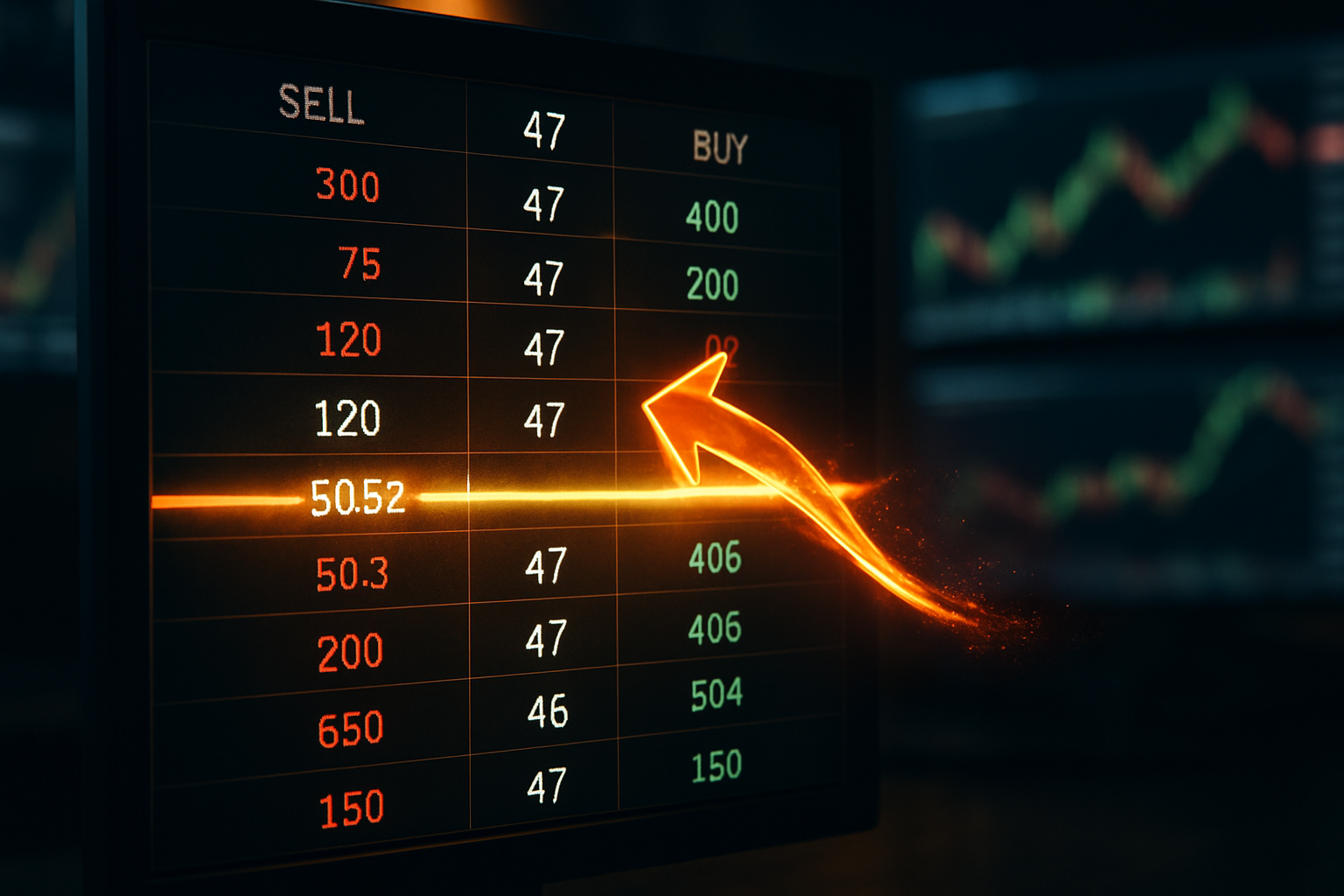
The single cheapest improvement most prediction market traders can make is to stop using market orders. A market order takes whatever price the order book offers, pays the full spread, and on Polymarket pays the taker fee. A limit order names your price and waits for someone to meet it — and on Polymarket, a limit order that rests on the book pays no fee at all and can earn a rebate. On a busy market the difference is a cent or two per contract. On a thin one it can be ten.
Limit orders on Polymarket and Kalshi work the same way in principle, with some differences in the details: which order types each venue offers, how fees apply, and how fine the price increments are. This guide covers both, with worked examples of what market orders actually cost, where to set a limit price, and the risks that come with waiting.
| Order type | What it does | When it fills | Fee treatment | Best used for |
|---|---|---|---|---|
| Market order | Buys or sells at the best available prices now | Immediately | Pays the spread and any taker fee | Urgent trades on liquid markets |
| Limit order (good till cancelled) | Rests at your price until filled or cancelled | When someone meets your price | No taker fee on Polymarket if it rests | Most trades |
| Limit order with expiry | Rests until a time you set | Until the deadline | Same as a limit order | Positions tied to an event |
| Fill-or-kill / immediate-or-cancel | Fills now at your price or cancels | Immediately or never | Taker fee on what fills | Bots and arbitrage legs |
Market Orders vs Limit Orders
Every market has a queue of resting orders. On the buy side, bids stack up at descending prices; on the sell side, asks stack up at ascending prices. A market order to buy fills against the asks from the lowest upward until it is complete. That is called walking the book, and it means large market orders pay progressively worse prices.
Here is a concrete example. Suppose the asks on a contract are 100 contracts at 52¢, 200 at 53¢ and 500 at 55¢. A market order for 600 contracts fills 100 at 52¢, 200 at 53¢ and the remaining 300 at 55¢. The total is $323, an average of about 53.8¢ — nearly two cents above the 52¢ ask you saw on screen. A limit order to buy 600 at 53¢ fills the first 300 immediately at 52–53¢ and leaves the other 300 resting at 53¢ until a seller arrives.
The limit order saves money on every contract it fills, but it may not fill completely. That is the entire trade-off: price certainty against fill certainty. Our guide to prediction market liquidity explains how to read book depth before deciding which one you need, and how prediction markets work covers the order book from the ground up.
How to Place a Limit Order on Polymarket
Polymarket's trading ticket offers both market and limit orders. The limit option lets you set a price and, optionally, an expiry.
- Open the market and choose the outcome and side you want to trade.
- Switch the order type from market to limit.
- Enter your limit price and the number of shares.
- Choose whether the order stays open until cancelled or expires at a set time.
- Review and submit, then check your open orders to confirm it is resting.
Polymarket's order book supports good-till-cancelled and good-till-date orders on the website, and fill-or-kill and fill-and-kill orders through its API, which is how most automated traders use it. Some markets price in increments as small as a tenth of a cent, particularly near the extremes of the price range.
The fee advantage is the main reason to use limits on Polymarket. Takers pay a fee of 0.75–1.80% depending on the market category, while resting orders that someone else fills pay nothing, and some markets pay makers a rebate of 20–50% of the fees collected. Polymarket also runs a liquidity rewards programme that pays makers for keeping competitive orders on the book. Our Polymarket fees explainer covers the category rates, and our Polymarket review covers the platform as a whole.
How to Place a Limit Order on Kalshi
Kalshi's order ticket also offers limit orders, and for most traders they should be the default.
- Open the market and choose YES or NO.
- Select a limit order and enter your price in cents.
- Enter the number of contracts.
- Set how long the order should stay open, if you want an expiry.
- Submit and confirm the order appears in your resting orders.
Kalshi quotes most markets in whole cents, with finer increments on some markets. Its standard fee — 0.07 × contracts × price × (1 − price), rounded up to the next cent — applies when your order takes liquidity from the book. Some markets also carry a smaller fee on resting orders, which Kalshi lists in its fee schedule, so check the specific market before assuming a limit order is free. Our Kalshi fees explainer walks through the formula, and our Kalshi review covers the rest of the platform.
Even where a fee applies to both sides, limit orders on Kalshi save money through the spread. Buying at your own bid of 44¢ rather than the 46¢ ask saves two cents a contract before any fee is counted, which on a 50¢ contract is worth more than the fee itself.
Where to Set Your Limit Price
The most common choice is to join the best bid when buying, or the best ask when selling. Your order joins the queue at that price and fills when enough sellers arrive. Most exchanges, including both of these, fill orders at the same price in the order they arrived, so joining an existing price level means waiting behind everyone already there.
The alternative is to improve the price by one tick. If the market is 44¢ bid, 47¢ ask, a bid at 45¢ goes straight to the front of the queue and is likely to fill sooner. You pay a cent more than the existing bid, but still two cents less than the ask. On markets with a wide spread, improving by a tick is usually the best balance between price and speed.
Avoid placing a limit order at or through the opposite side unless you want an immediate fill. A buy limit at 47¢ when the ask is 47¢ is effectively a market order: it fills at once and pays the taker fee. That is fine when you want speed, but it defeats the purpose if you wanted to save the spread. Our market fee calculator shows the cost difference between taking and resting at any price.
The Risks of Limit Orders
You may not get filled. A limit order below the market stays unfilled if the price moves away. If you wanted the position, you have to decide whether to chase it or let it go. Chasing a moving market with repeated limit orders often ends up costing more than a market order would have.
You get filled when you least want to be. This is adverse selection, and it is the more serious risk. Your resting bid is most likely to fill when someone with better information wants to sell — for example, seconds after bad news that you have not seen. On fast-moving markets, a resting order is a free option you give to anyone quicker than you.
Forgotten orders fill at the wrong time. A limit order placed days ago, at a price that made sense then, can fill during a news event when the price should have moved far beyond it. Before any scheduled event — a Fed decision, a game, an election night — review your resting orders and cancel anything you would not place fresh. The Fed rate odds show how quickly a macro market can swing 20 points around a release.
Limit Orders on Thin Markets
On a thin market, a limit order is not just cheaper; it is often the only sensible way to trade. PredictReport's tracker shows quoted spreads of three to five cents on several NFL MVP candidates on Polymarket, and on the Nobel Peace Prize market Kalshi has quoted the Committee to Protect Journalists at 2¢ bid and 6¢ ask. A market order on a book like that pays a large share of the contract's value in spread alone.
The approach that works is to place a limit order inside the spread and wait. If the market is 2¢ bid, 6¢ ask, a bid at 3¢ or 4¢ may fill over hours or days as other traders cross it. That patience is the whole edge. Our NFL MVP odds explain why the thinner venue's prices should be treated with caution, and our Nobel Peace Prize odds show how a single market order on a thin book can print a price far from fair value.
Limit Orders and Arbitrage
Cross-venue arbitrage has two legs — buying YES on one venue and NO on another — and execution risk lives in the gap between them. If you fill one leg and the other moves before you can fill it, you are left holding a one-sided position.
The standard technique is to rest a limit order on the leg with the thinner book and take the leg with the deeper book only once the first fills. That way the risky leg is the one you control. It also saves the taker fee on one side, which can be the difference between a profitable arbitrage and a break-even one. Our arbitrage guide covers the full workflow, and our arbitrage scanner shows which gaps currently survive fees.
Using Limit Orders Like a Market Maker
A trader who rests both a bid and an ask on the same market is market making: offering to buy slightly below fair value and sell slightly above it, and earning the spread when both sides fill. On Polymarket, that trader also avoids taker fees and may collect maker rebates and liquidity rewards. It is the most direct way to be paid rather than to pay for the order book.
It is also a specialised business with real risks, above all adverse selection and inventory: when the price moves, one side of your quote fills and the other does not. Our guide to market making on prediction markets covers the economics in detail. Most traders do not need to go that far, but understanding it explains why the people on the other side of your market orders exist.
What Limit Orders Save Over a Year
The savings look small per trade and large over a year. Take a trader who makes 100 trades a year on Polymarket, 500 contracts at a time, at prices around 50¢, on markets with a two-cent spread.
| Cost per year | Market orders | Limit orders that rest |
|---|---|---|
| Half the spread, paid on every trade | About $500 | About $0 |
| Taker fee at the top of Polymarket's range | About $450 | $0 |
| Maker rebates collected | $0 | Some markets pay them |
| Total trading cost | About $950 | Close to zero, before any rebate |
That is roughly $950 of cost on $25,000 of volume — close to 4% — which is larger than the edge most retail traders have on any single market. The comparison assumes every limit order fills, which they will not, but even if half of them end up as market orders, the saving is several hundred dollars.
Put differently, the choice of order type can decide whether a year of otherwise break-even trading ends up or down. Our guide to making money on prediction markets covers the strategies themselves, and the take-home calculator shows what fees and tax leave you from any year's gross profit.
A Simple Limit-Order Routine
Check the spread before every trade. If it is a cent or less, a market order costs little and fills instantly. If it is two cents or more, use a limit order at or just inside the best price on your side.
Size to the book. If you want 1,000 contracts and the top of the book has 200, split the order or rest it rather than walking up several price levels. Set an expiry on any order tied to an event, so it cannot fill after the event has changed everything. And cancel stale orders before scheduled news.
None of this requires a strategy or an edge. It simply stops the mechanics of trading from eating the edge you already have. If you are new to prediction markets, our beginner's walkthrough covers the first trade, and our ranking of the best prediction market apps compares venues on fees and order types. For the costs of getting out of a position, see our guide to cashing out early.
Frequently Asked Questions
What is a limit order on Polymarket?
An order to buy or sell at a specific price or better. It rests on the order book until someone meets your price, and when it rests and is filled by another trader, it pays no taker fee.
Does Kalshi have limit orders?
Yes. Kalshi lets you set a limit price in cents and an optional expiry. Its standard fee applies when an order takes liquidity, and some markets also charge a smaller fee on resting orders.
Are limit orders free on Polymarket?
Resting limit orders that another trader fills pay no fee, and some markets pay makers a rebate of 20–50% of fees collected. Taker orders pay 0.75–1.80% depending on the market category. See our Polymarket fees explainer.
Why didn't my limit order fill?
Because no one was willing to trade at your price, or because orders at the same price ahead of you filled first. You can wait, improve your price by a tick, or cancel.
Should I use market orders or limit orders on prediction markets?
Limit orders for most trades, and market orders only on liquid markets with a spread of a cent or less, or when you need to act immediately. On thin markets, market orders can cost several cents per contract.
What is walking the book?
When a large market order fills against several price levels, paying a worse price at each. A 600-contract order against 100 at 52¢, 200 at 53¢ and 500 at 55¢ averages about 53.8¢.
What is adverse selection with limit orders?
The risk that your resting order fills precisely because the price is about to move against you, often when someone else has seen news first. Cancel resting orders before scheduled events.
Can limit orders help with arbitrage?
Yes. Resting a limit on the thinner leg and taking the deeper leg only after it fills reduces execution risk and saves a taker fee. Our arbitrage guide explains the process.