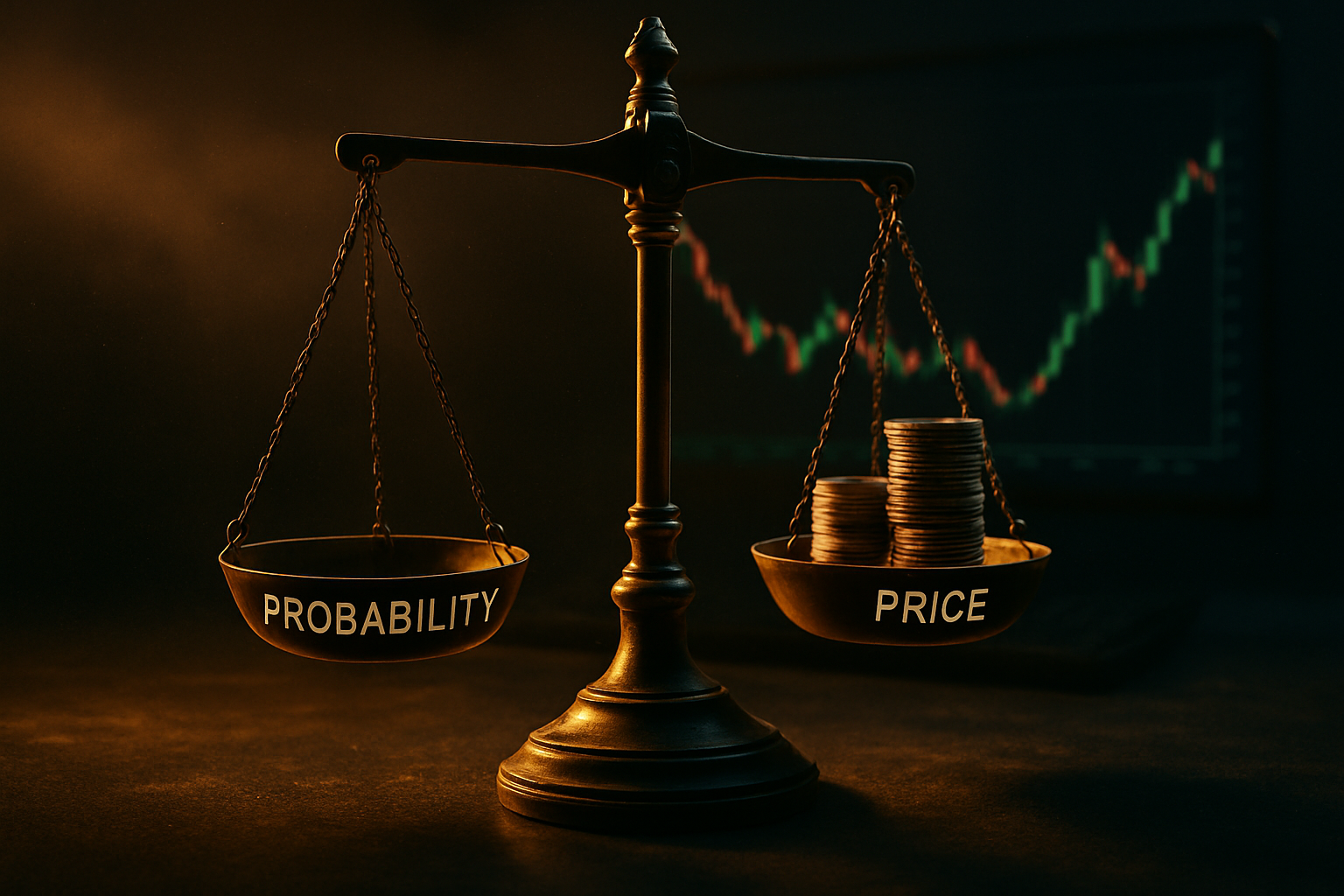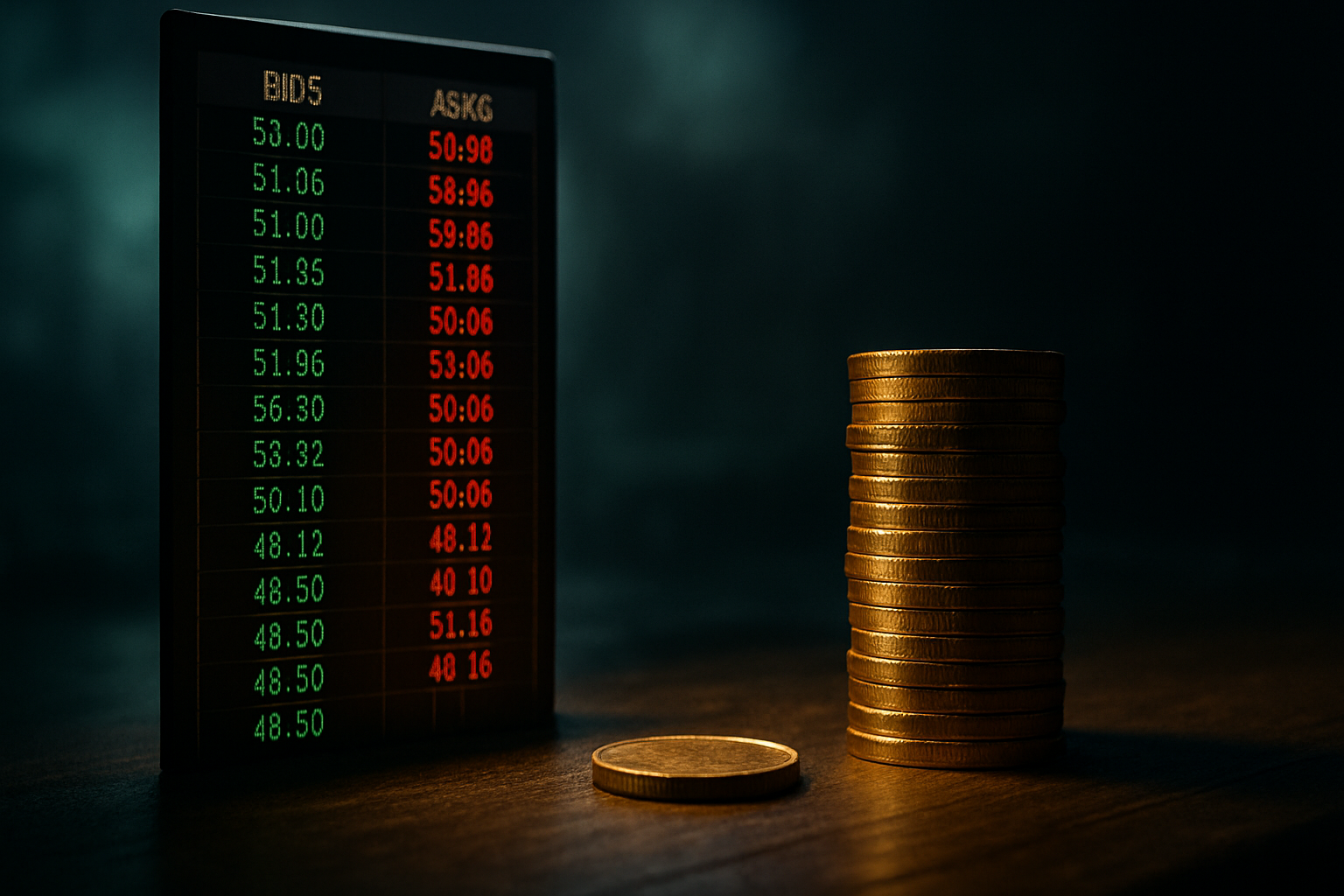
The price on your screen is only real for the size someone is willing to trade. That gap — between the quote and what you can actually get filled — is liquidity, and on prediction markets it is the cost that does the most damage to accounts while appearing on no fee schedule.
What the order book is telling you
Every market has a best bid and a best ask. The bid is the highest price someone will pay for YES; the ask is the lowest price someone will sell at. The distance between them is the spread.
A market quoting 51/52 has a one-cent spread. A market quoting 45/58 has thirteen. Both might show a "price" of around 51 or 52 cents in a listing, and they are completely different propositions.
On the tight market, buying and immediately selling costs you a cent. On the wide one it costs thirteen — a quarter of your stake, gone, before the event has done anything. Any edge you thought you had is now a rounding error against that.
Depth is the other half
The spread tells you the cost of a small trade. Depth tells you what happens when the trade is not small.
Behind the best ask sits a queue: some contracts at 52¢, more at 53¢, more at 55¢. Buy more than the top of the book holds and you walk up that queue, paying progressively worse prices. The average price you get — your fill — is worse than the quote you clicked.
This is why volume figures matter. Kalshi runs roughly $9.8 billion monthly and Polymarket around $7 billion; those numbers mean the top of book on a major market is deep enough that a retail-sized order does not move it. On a market doing a few thousand dollars a day, a $500 order can be the whole book.
Why it matters more than fees
Fees are visible and bounded. Kalshi's formula caps out around 1.75¢ per contract at a coin flip. Polymarket takers pay 0.75–1.80%.
Spreads are invisible and unbounded. A six-point spread on a thin market costs you six cents per contract — three times Kalshi's worst-case fee — and nothing in the interface calls it a fee.
This is the honest caveat on every zero-commission pitch in the category, including Novig's. A venue charging nothing on a market quoted 45/58 is more expensive than one charging a fee on a market quoted 51/52. Compare the all-in cost, not the headline rate — our fee calculator handles the fee half, and the spread half you read off the book.
How to read liquidity before trading
Check the spread first, not the price. If it is wider than your expected edge, the trade is already dead. Two cents is fine, ten is not.
Look at what sits behind the top. If the best ask is 200 contracts and you want 1,000, you are paying the next four levels too.
Check volume on the specific market, not the venue. A platform doing billions can still list a market that has traded $400 all week.
Ask how you get out. Plenty of positions are easy to enter and impossible to exit at a sane price. If you might need to close before resolution, you need liquidity on both sides.
Where liquidity actually is
It concentrates ruthlessly. On both major venues, a handful of markets carry most of the volume: the 2028 nomination books, major-league games, Fed decisions. Everything else is thinner by an order of magnitude or two.
Sports drive more than 80% of category volume, and within sports it concentrates again into the biggest leagues. An NFL game has a deep book; a Tuesday WNBA game does not. A presidential nomination market has a deep book; a market on a minor award does not.
The pattern to internalise: liquidity follows attention, and attention is far more concentrated than the number of listed markets suggests.
Maker versus taker
Crossing the spread to get filled immediately makes you a taker. Posting your own price and waiting makes you a maker.
Makers avoid the spread entirely — you set your price rather than accepting someone else's — and on Polymarket they pay no fee and can collect rebates of 20–50% on some markets. The cost is that you might not get filled, and on a market moving away from you, not getting filled is itself expensive.
On thin markets this trade-off is the whole game. Taking on a wide book is brutal; posting patiently is often the only sensible way in.
Liquidity and arbitrage
Cross-venue arbitrage lives or dies on this. A gap between Polymarket and Kalshi is only tradeable if both legs can actually be filled — and the markets where the biggest gaps appear are frequently the thin ones where they cannot.
This is why our arbitrage scanner requires a two-sided book on both venues before showing an opportunity. A lone ask with no bid behind it is not a market you can trade; it is a price nobody is standing behind. Filtering those out removes a lot of apparent opportunities, which is the point — they were never real.
Practical rules
Trade where the volume is, at least until you know what you are doing. Check the spread before the price. Size to the book rather than to your conviction. Post limit orders on anything thin. And before entering a position you might need to exit early, look at the bid side, because that is where you will be selling.
None of this makes you money by itself. It stops a decent edge from being eaten by the mechanics of getting in and out, which is how most of them die.
Frequently Asked Questions
What is liquidity in a prediction market?
How easily you can trade at the quoted price. A liquid market has a narrow spread between bid and ask and enough size behind each to absorb your order without moving the price.
What is a good spread on a prediction market?
One or two cents on a liquid market. Anything above five points usually means nobody is actively quoting, and crossing it costs more than any venue's fee.
Why does the spread matter more than the fee?
Because it is larger and invisible. Kalshi's fee peaks near 1.75¢ per contract; a thin market can cost six cents or more in spread, and nothing labels it as a cost.
Which prediction market has the best liquidity?
Polymarket and Kalshi run the deepest books overall — roughly $7 billion and $9.8 billion monthly volume. Within either, liquidity concentrates in a small number of markets rather than spreading evenly.
How do I avoid paying the spread?
Post a limit order at your own price instead of crossing to the ask. You become a maker, pay no spread, and on Polymarket pay no fee and may collect a rebate — at the cost of possibly not being filled.
Can I always sell before a market resolves?
Only if someone is bidding. On thin markets the exit can be far worse than the entry, which is why the bid side is worth checking before you buy.