You can make your first prediction market trade in about ten minutes. Most of that is verification. The trade itself takes seconds, and the part worth slowing down for is the two minutes before it.
This walks through the whole thing: choosing a venue, funding, reading a market, placing an order, and the specific mistakes that cost beginners money in the first week.
Step 1: Pick a venue
Three sensible starting points, depending on what you want.
Kalshi if you want dollars and breadth. CFTC-regulated, settles in US dollars from a bank account, no crypto anywhere in the process, and it lists politics, economics and crypto markets alongside sports. It also pays roughly 4% on idle cash. Available in 40-plus states. Our Kalshi review has the detail.
Polymarket if you want the deepest books and the widest catalogue, and you are comfortable with a crypto wallet. It settles in USDC on Polygon, which is an extra layer to learn — our deposit guide walks through it.
Novig if you only care about sports and want zero commission. Sports-only across eight leagues, dollars, 47 states plus DC, 21+. See the Novig review.
For a first account, Kalshi is the path of least resistance for most US readers. The wider field is ranked in best prediction market apps.
Step 2: Fund it
Verification first — name, date of birth, address, usually an ID document. This is a regulatory requirement on any CFTC-licensed venue, not an optional step, and doing it now saves a blocked withdrawal later.
Then deposit. Start small. Not because the platforms are untrustworthy, but because your first several trades are tuition and you should pay as little of it as possible. A hundred dollars is plenty to learn the mechanics.
Step 3: Understand what you are buying
This is the part that actually matters.
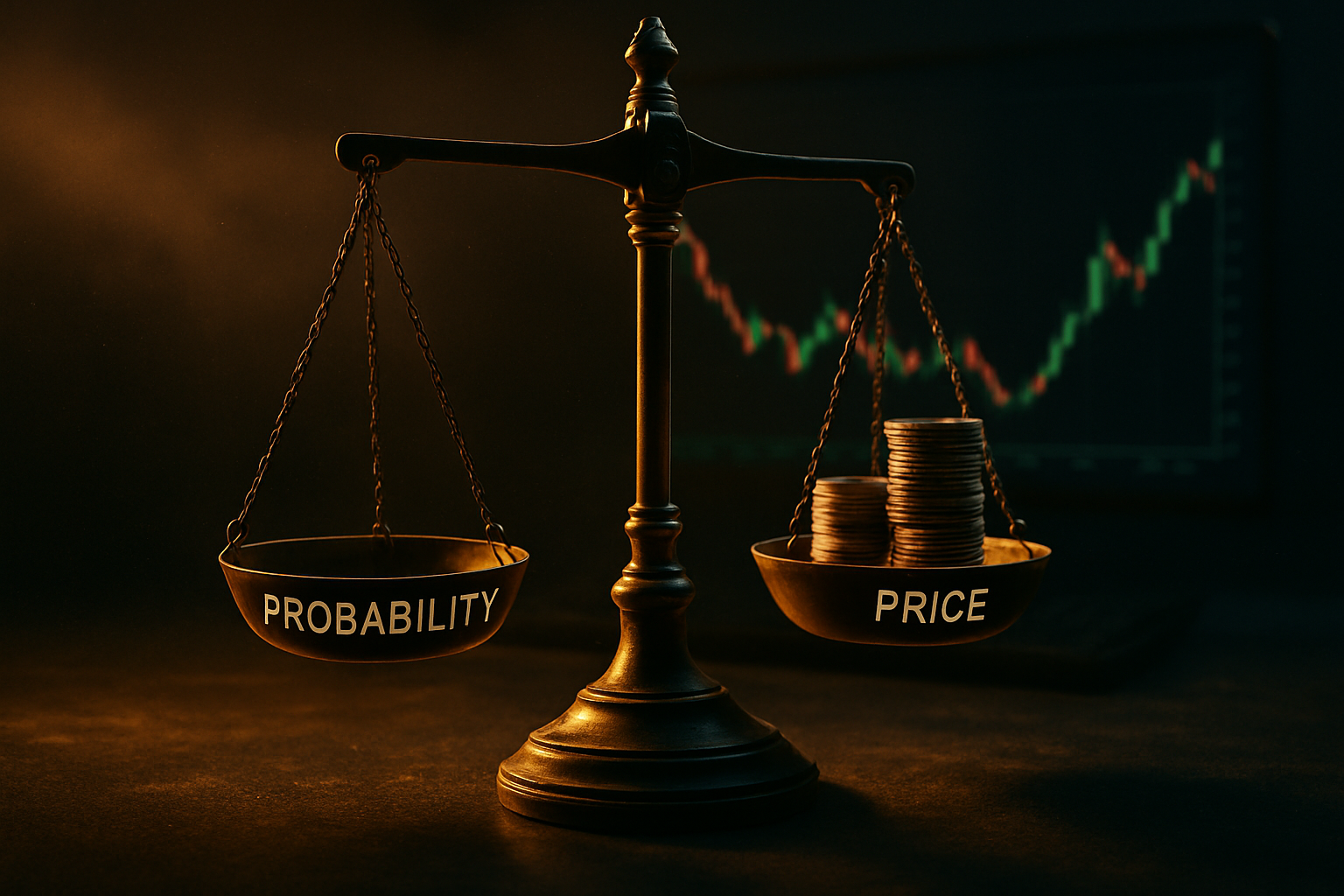
A contract settles at $1 if the event happens and $0 if it does not. The price is the probability: a contract at 30¢ means the market gives it a 30% chance.
Buy at 30¢ and you are risking 30¢ to make 70¢. If you are right, the contract pays $1 and your profit is 70¢ on a 30¢ stake. If you are wrong, the 30¢ is gone.
That is the entire instrument. There is no spread to cover, no odds format to decode, no bookmaker's margin hidden in a number — though there is a small one hidden in the gap between the two sides, which our vig guide explains.
Every position also has a NO side. Buying NO at 70¢ is the same bet as selling YES at 30¢, and sometimes one side is better priced than the other.
Step 4: Read the market before you trade it
Two minutes, and almost nobody does it.
Read the resolution criteria. Who decides, using what source, by what deadline, and what happens if the event is cancelled or ambiguous? A market's title is a summary; the rulebook is the agreement, and the gap between them is where beginners lose money. Our guide to how markets resolve covers the traps.
Check the spread. Look at the bid and the ask, not just the last price. A market quoting 51/52 is cheap to trade. One quoting 45/58 costs you thirteen cents to enter and exit, which will swamp any edge you think you have.
Check there is size behind the quote. A great price for ten contracts is irrelevant if you want a hundred.
Step 5: Form your own view first
Write down what you think the probability is before you look at the price. This sounds fussy and it is the single most useful habit in this category.
Look at the price first and your estimate drifts toward it — anchoring is real and you are not immune. Write your number down, then compare.
If your number and the price are within a cent or two, pass. There is no edge, and the fee will make it a losing trade. If the gap is larger, ask why you think you know better than a market that is right about 94% of the time. Polymarket's markets post Brier scores around 0.09; that is the bar.
Our expected value guide covers the arithmetic, and the calculator does it for you.
Step 6: Place the order
Market order fills immediately at whatever is available. Simple, and you pay the spread.
Limit order sets your own price and waits. You may not get filled, but you avoid crossing the spread — and on Polymarket, limit orders that rest make you a maker, which means no fee and sometimes a rebate.
For a first trade on a liquid market, a market order is fine. On anything thin, use a limit order.
Size small. Whatever number feels right, halve it. A 60% position still loses 40% of the time, and four losses in a row is a completely normal thing that happens to about one trader in forty.
Step 7: Know your exits
You do not have to hold to resolution. Positions can be sold at any time the market is open, which is one of the real differences from a placed bet.
That cuts both ways. You can take a profit when a market moves your way, and you can cut a position when new information says you were wrong. You can also panic-sell a good position during a wobble, which is the more common outcome.
Decide before entering what would make you exit. Not a price — a reason.
The five mistakes that cost beginners money
Trading the headline, not the contract. The rulebook decides, not the news.
Ignoring the spread. A thirteen-point spread costs more than any edge you have.
Sizing on conviction. Confidence is not probability, and a real edge staked too large still bankrupts you.
Chasing long shots. Contracts at 3–5¢ are systematically overpriced across nearly every prediction market — the same favourite-longshot bias that shows up in racing. They feel like lottery tickets and are priced like them.
Forgetting fees and tax. Kalshi's fee peaks near 1.75¢ per contract; profits are reportable whether or not you withdraw. Run the numbers through our fee and take-home calculators before deciding you are up.
After the first trade
Track everything — entry price, your probability, the outcome. After thirty or so, compare your estimates against what actually happened. That tells you whether you have an edge, which is the only question that matters and the one most people never answer.
Then read how prediction markets work for the mechanics in full, and our live odds comparison to see the same markets priced on two venues at once — often the cheapest lesson available in how pricing actually behaves.
Frequently Asked Questions
How much money do I need to start?
Very little. Novig's minimum deposit is $1 and Kalshi's is low. A hundred dollars is enough to learn the mechanics, and treating the first few trades as tuition is the right frame.
What is the easiest prediction market for beginners?
Kalshi for most US readers: dollars from a bank account, no crypto, broad market selection, and federal regulation. Novig is simpler still if you only want sports.
Do I need crypto to use prediction markets?
Not on Kalshi or Novig, which settle in US dollars. Polymarket uses USDC on Polygon, which needs a wallet — see our deposit guide.
Can I sell before the event happens?
Yes, at any time the market is open, which is a genuine difference from a placed bet. The price you get depends on what someone is bidding.
What does a contract price mean?
The price is the implied probability. A contract at 30¢ means a 30% chance, costs 30¢, and pays $1 if the event happens.
Will I make money?
Most retail participants lose over time. Prediction markets are well calibrated — roughly 94% accurate — so beating them requires genuinely better information, not a strong opinion. Start small and track your results before scaling anything.