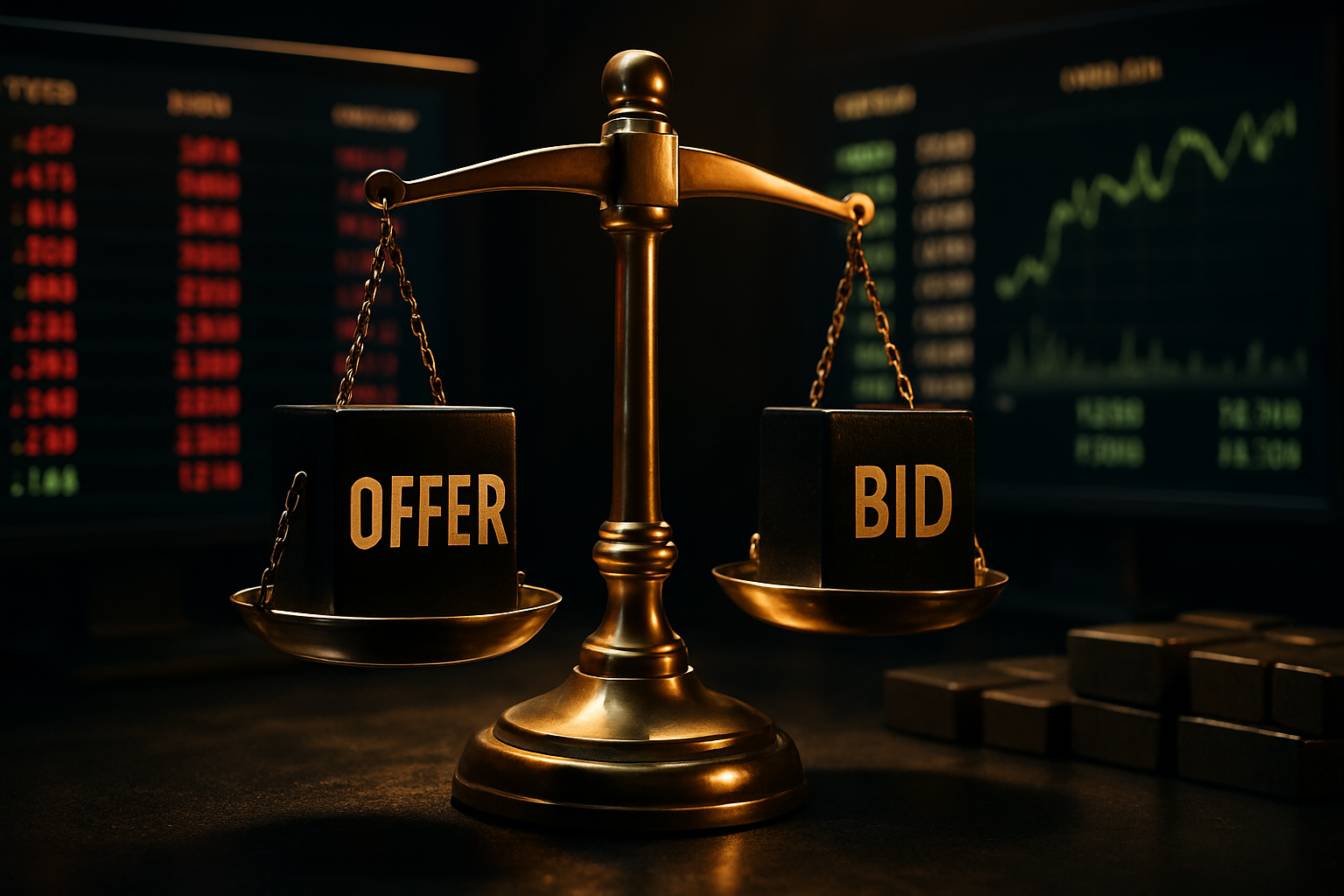
Every time you buy at the ask or sell at the bid on a prediction market, someone was already waiting there. That someone is a market maker: a trader who posts offers to buy and sell at the same time, and earns the gap between them when both sides fill. On Polymarket, market makers also pay no fee on their resting orders, can collect rebates of 20–50% on some markets, and are paid through a liquidity rewards programme for keeping competitive quotes on the book.
Market making on prediction markets is the most direct way to be paid by the order book rather than to pay it. It is also a business with real risks that sink most people who try it casually — above all, the risk of being filled precisely when the price is about to move against you. This guide covers how market makers earn money on Polymarket and Kalshi, what they risk, how they manage inventory, which markets suit the strategy, and a worked example of the economics.
| Source of profit or cost | How it works | Typical size |
|---|---|---|
| Spread capture | Buy at your bid, sell at your ask | The spread you quote, per round trip |
| Maker fees | Polymarket charges resting orders nothing | Saves 0.75–1.80% versus taking |
| Maker rebates | Some Polymarket markets rebate makers | 20–50% of fees collected |
| Liquidity rewards | Polymarket pays for competitive quotes | Varies by market and period |
| Adverse selection | You get filled just before the price moves | Often larger than the spread |
| Inventory risk | You hold positions between fills | Grows with position size |
What a Market Maker Does
A market maker quotes both sides of a market at once. Suppose you think a contract is worth 50¢. You post a bid to buy 200 contracts at 49¢ and an offer to sell 200 at 51¢. If a seller hits your bid and a buyer lifts your offer, you have bought at 49¢ and sold at 51¢, earning 2¢ per contract — $4 on 200 contracts — without taking any view on the outcome.
Repeat that many times a day and the pennies add up. The catch is that both sides rarely fill in neat pairs. Often only one side fills, leaving you holding a position — inventory — that you did not particularly want. Managing that inventory, and avoiding fills that happen for the wrong reasons, is the actual job. Our guide to limit orders covers the order mechanics that market making is built on, and how prediction markets work explains the order book itself.
Market makers are the reason prediction markets have prices at all outside the busiest moments. Without someone willing to quote both sides, a buyer would have to wait for a seller to arrive, and spreads would be far wider. Our guide to prediction market liquidity explains how their presence shows up in book depth.
How Market Makers Earn Money on Polymarket
Polymarket is structured to reward makers. Takers — traders who cross the spread to fill immediately — pay a fee of 0.75–1.80% depending on the market category. Makers, whose resting orders are filled by someone else, pay nothing. On some markets, makers receive a rebate of 20–50% of the fees collected, so they are paid for providing the liquidity that takers use.
On top of that, Polymarket runs a liquidity rewards programme that pays makers for keeping orders on the book close to the midpoint. The general principle is that tighter, larger quotes that stay up longer earn more, which encourages makers to keep markets tradeable even when fills are slow. The specific parameters vary by market and change over time, so check the current programme before building a strategy around it. Our Polymarket fees explainer covers the fee side, and our Polymarket review covers the platform.
The result is that a Polymarket market maker can be profitable on a market even when spread capture alone would not cover the risk. That is the design intent: rewards and rebates pay makers to take risks that improve the market for everyone else.
Market Making on Kalshi
Kalshi's fee structure charges most of its fee to the taker. Its standard fee — 0.07 × contracts × price × (1 − price), rounded up to the next cent — applies when an order takes liquidity, while some markets also carry a smaller fee on resting orders, listed in Kalshi's fee schedule. Our Kalshi fees explainer walks through the formula.
Kalshi has also courted professional market makers directly. Susquehanna International Group became a market maker on the exchange in 2024, and institutional liquidity providers now quote many of its larger markets, particularly in sports. For a retail trader, that means competing with firms that have better technology and more capital on the busiest markets, and finding opportunities on the less crowded ones.
One Kalshi-specific advantage is interest. Kalshi pays roughly 4% a year on idle cash, which lowers the cost of keeping capital on the platform for market making. Our Kalshi review covers the interest programme and the API access automated traders use.
Adverse Selection: The Main Risk
The most dangerous fill for a market maker is the one that happens because someone knows more than you. If news breaks that makes a contract worth 60¢, the first traders to see it will buy everything offered below 60¢ — including your offer at 51¢. You have sold at 51¢ something now worth 60¢, a loss of 9¢ per contract that wipes out the spread from several profitable round trips.
That is adverse selection, and it is why market making on fast-moving markets is so hard. On a live sports market, a touchdown or an injury can move the price 20 points in seconds, and a resting quote is a free option handed to whoever sees the play first. On a political market, a leak or a surprise announcement does the same. Our Nobel Peace Prize odds describe how a leak before the 2025 announcement moved one candidate from under 4% to over 70% in two hours; anyone quoting that market was run over.
The defences are speed and selectivity. Automated market makers pull or widen their quotes the moment related prices move or news arrives. Human market makers cannot react that fast, so they do better on markets where information arrives slowly and on schedule.
Inventory Risk and Skewing Your Quotes
When only one side of your quote fills, you hold inventory. If your bid fills three times and your offer once, you are long, and a falling price now costs you money on the whole position. Every market maker has to decide how much inventory to tolerate and what to do when it builds up.
The standard technique is to skew. If you are long more than you want, you lower both your bid and your offer: the lower offer makes it more likely someone buys your excess, and the lower bid makes it less likely you buy more. If you are short, you raise both. Skewing gives up a little spread in exchange for steering your inventory back toward neutral.
Another tool is hedging on the other venue. A market maker who has accumulated YES on Polymarket can sometimes offset it by buying NO on Kalshi, locking in the position's current value. That turns market making into a form of cross-venue arbitrage, which our arbitrage guide covers and our arbitrage scanner monitors.
Choosing Markets to Make
Good markets for market making share four features. The spread is wide enough to pay for the risk — a market already quoted 50¢ bid, 51¢ ask leaves little room. There is steady two-way flow, so both sides of your quote fill regularly. Information arrives slowly or on a schedule, so you are rarely caught by surprises. And resolution is far enough away that the contract does not jump to $1 or $0 while you hold it.
Long-dated political and award markets often fit. A 2028 nomination contract moves slowly most days, has steady flow, and gives you time to manage inventory. Live sports markets during games are the opposite: fast, information-driven and dominated by automated firms. Short-dated crypto markets fall in between but reward speed above all — our guide to bitcoin prediction markets explains why the final minute belongs to automated traders.
Whatever the market, avoid quoting through scheduled events. A resting quote at the moment of a Fed decision, a jobs report or an election result is almost guaranteed to be filled on the wrong side.
Prediction markets also have a feature that stock and crypto markets do not: every contract ends at exactly $1 or $0. That shapes the risk. Near the middle of the range, a contract can move a long way in either direction, so inventory is dangerous but spreads tend to be wider. Near the extremes, a contract at 95¢ can only rise 5¢ but can fall 95¢, so a market maker holding YES there carries a lopsided risk that the spread rarely pays for. As resolution approaches, prices converge toward one end and the market-making opportunity disappears. Our explainer on how prediction markets resolve covers the settlement mechanics that make that convergence abrupt.
The Economics of a Market-Making Day
A simplified example shows why the maths is tighter than it first appears. Suppose you make a market quoting 2¢ wide, in 200-contract clips, and complete 50 round trips in a day. Spread capture earns 50 × 200 × 2¢, or $200.
| Item | Amount |
|---|---|
| Spread capture: 50 round trips, 200 contracts, 2¢ | +$200 |
| Adverse selection: 10 fills before a 5¢ move, 200 contracts | −$100 |
| Maker fees on Polymarket | $0 |
| Maker rebates and liquidity rewards | Varies — often the margin of profit |
| Net before rewards | +$100 |
Now suppose ten times during the day you are filled just before the price moves 5¢ against you. Each costs 200 × 5¢, or $10, for a total of $100. Half the day's spread income is gone. On a busier, more volatile day, adverse selection can exceed the spread entirely, and rewards and rebates become the difference between a profitable and a losing day.
That is why most successful market making is automated. Software can quote dozens of markets at once, pull quotes in milliseconds, and manage inventory continuously. Our guide to prediction market APIs covers the tools, and our analysis of AI trading bots covers how much of the category's volume is now automated.
Measuring Whether It Is Working
A market maker who only watches the account balance cannot tell why it is going up or down. Split the results into three parts: spread captured on completed round trips, gains and losses on inventory from price moves, and rewards and rebates. If spread capture is healthy but inventory losses keep eating it, you are being adversely selected and should widen quotes or quote fewer markets. If rewards are doing all the work, your strategy depends on a programme that can change.
On Polymarket, every fill is recorded on-chain, which makes this analysis easier than on most venues. Public dashboards built on on-chain data let you examine fills, counterparties and the behaviour of the largest wallets; our Dune Analytics review covers the most widely used tool. On Kalshi, the account history and API give you the same data privately.
Common Market-Making Mistakes
Quoting too tight. A one-cent spread on a volatile market pays less than a single bad fill costs. Match the spread to the risk.
Quoting too large. A big resting order is a big target for anyone with better information. Start with small clips and grow only where fills prove profitable.
Leaving quotes up through events. Scheduled releases, games and announcements are when resting orders are picked off. Pull quotes beforehand.
Ignoring the cost of hedging. Offsetting inventory on another venue usually means taking liquidity and paying a taker fee. Our market fee calculator shows what each hedge costs before you place it.
When Market Making Is Worth It for Retail Traders
For most people, full market making is not worth attempting by hand. The competition is automated, the risk is concentrated in moments you cannot see coming, and the profit per trade is small. Our overview of how to make money on prediction markets puts market making alongside the other strategies traders use, and it is one of the more demanding.
A lighter version is worth adopting by everyone: use limit orders instead of market orders, and let the book come to you. You capture part of the spread on every trade you would have made anyway, avoid taker fees on Polymarket, and take on far less risk than a two-sided market maker. That single change is the most practical lesson market making offers.
Profits from market making are taxable when realised, and high-frequency strategies generate many taxable events; see our prediction market tax guide. For choosing a venue, Polymarket vs Kalshi and our ranking of the best prediction market apps cover the options.
Frequently Asked Questions
What is market making on Polymarket?
Posting bids and offers on the same market at once, and earning the spread when both fill. Polymarket charges makers no fee, pays rebates on some markets, and rewards competitive quotes through a liquidity programme.
How much do market makers earn on prediction markets?
It varies widely. Spread capture of a cent or two per contract is often offset by adverse selection, and rebates and liquidity rewards frequently make the difference between profit and loss.
What is adverse selection in market making?
Being filled because another trader knows the price is about to move. If news makes a contract worth 60¢, your offer at 51¢ is filled immediately, costing 9¢ per contract.
Does Kalshi pay market makers?
Kalshi works with professional liquidity providers, including Susquehanna since 2024. Its fee falls mainly on takers, though some markets carry a smaller fee on resting orders. See our Kalshi review.
Can I do market making manually?
On slow, long-dated markets it is possible, but most market making is automated because quotes must be pulled within milliseconds of news. For most traders, simply using limit orders captures part of the benefit.
What is inventory risk?
The risk from positions you accumulate when only one side of your quote fills. Market makers manage it by skewing their quotes or hedging on another venue.
Which markets are best for market making?
Markets with a wide enough spread, steady two-way flow, slow or scheduled information and distant resolution. Long-dated political markets often fit; live sports and short-dated crypto markets favour automated firms.
Are market-making profits taxable?
Yes, when realised, and frequent trading creates many taxable events. See our prediction market tax guide.